
Josephine Burton: We Are Free

Image credit: Photo of Josephine Burton
For two decades, Josephine Burton has shaped Dash Arts into one of London’s most inquisitive, boundary-expanding cultural forces – a home for work that folds together languages, communities and lived experience with rare honesty and imagination. As Dash marks its 20th anniversary, Josephine turns her gaze to the future with We Are Free to Change the World, a new three-part series created in partnership with Artsadmin and the Brian Eno-initiated Fête of Britain.
Opening at Toynbee Hall, the first event – ‘Ready’ – brings together an extraordinary line-up: Carole Cadwalladr, Sam Lee, Bishi Bhattacharya and Lehni Lamide Davies, gathering to ask what it truly takes to begin. It’s an invitation rooted in Josephine’s long-held values: curiosity, plurality, connection, and a deep love for the restless, generous ecosystem of London – the city that continues to ignite her work, and her hopes for what comes next.
Let’s begin with your origin story. Before Dash Arts – what were the early sparks? Was there a moment, a mentor, or a piece of work that nudged you toward the kind of artist, curator and leader you’ve become?
I started out as a singer, so my entry into the arts was very bodily and instinctive – I loved the alchemy of voices in a room, the way performance reshapes you from the inside. I remember seeing De La Guarda at the Roundhouse in my early twenties and feeling something click: art didn’t need to sit politely on a stage. It could lift you, tilt you, shake you out.
I was obsessed with the clarity and curiosity of Peter Brook, the visual poetry and politics of Shirin Neshat, the sonic worlds that Matthew Herbert and Nitin Sawhney were building. Those artists made me feel that boundaries between forms were porous – that the most exciting work happens in the gaps.
I nearly went to the Courtauld to do a Masters in art history, but at the last minute realised I didn’t want to study work; I wanted to learn by doing, by collaborating, by sometimes succeeding and often failing. And I couldn’t see spaces where genuinely international, interdisciplinary work could grow. So I started creating those spaces. That impulse – to make room for encounters that wouldn’t otherwise happen – became Dash Arts, and somehow twenty years have passed.
We Are Free to Change the World arrives at a moment when many people feel overwhelmed. What sparked this trilogy – Ready, Steady, Go – and why does this structure feel right for now?
It began with Lyndsey Stonebridge’s book on Hannah Arendt. Arendt believed that freedom begins the moment we act – not when we dream or discuss, but when we begin. That idea lodged itself in me.
The trilogy came from wanting something clear and human. Ready, Steady, Go sounds simple, childlike, but simplicity feels important right now. We’re so saturated with crises that many people don’t know where to begin. I wanted a structure that felt open, honest and doable – a way of saying: Let’s start at the beginning. Let’s take this one step at a time. Let’s act together.
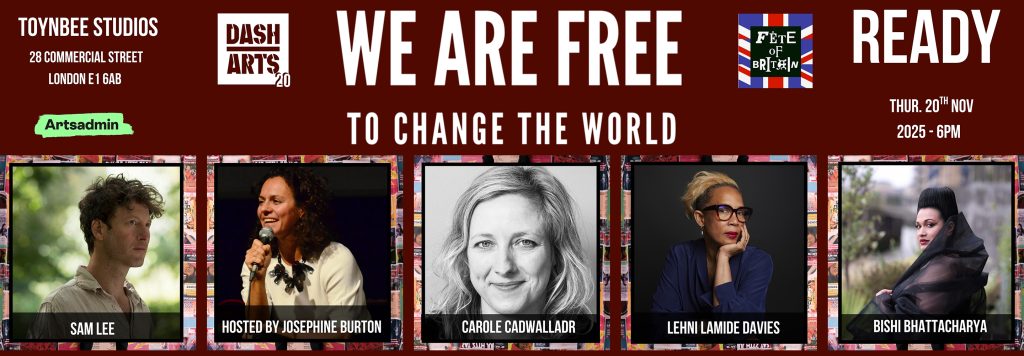
Image credit: Flyer for We are Free, announcing speakers Carol Caldwelladr, Sam Lee, Bishi Bhattacharya and Lemmi Lamide Davies. Hosted by Josephine Burton. 20 November 2025 at Toynbee Studios.
The first event asks: what does it take to prepare for change? What does “readiness” look like today, and who do you hope feels called to join this conversation?
Readiness today doesn’t look like having all the answers – quite the opposite. It looks like curiosity, humility, and the willingness to show up even when things feel messy or uncertain.
We’re bringing together artists, activists and thinkers because they each have a different way of making sense of the world. People I admire and would love to hear talk about their work. “Ready” asks: What helps you begin? It might be anger, grief, joy, craft, community – or simply the knowledge that you’re not acting alone.
Who’s it for? Anyone who feels stuck but wants to move. Anyone who senses that things could be different but isn’t sure where to start. Anyone who still believes, stubbornly, that imagination matters.
Dash Arts, Artsadmin and Fête of Britain – that’s quite a coalition. What does this partnership unlock?
All three of us believe that creativity and citizenship belong together. Artsadmin have been nurturing activist and socially engaged practice for decades. Fête of Britain is reimagining democratic participation from the ground up. Dash has always tried to build spaces where art and lived experience meet.
Working together feels like overlapping circles – suddenly the space in the middle gets bigger, more porous, more alive. We share audiences, tools, values, questions. We don’t always agree, which is even better; I think Arendt would call that “plurality”, and she believed that’s where real freedom lives.
For anyone wanting to prepare for change – artistically, emotionally, politically – where should they begin?
Begin small. Begin where you are. Begin with others.
Often, thinking of the destination and the ultimate goal is petrifying. I certainly had no idea that Dash would be celebrating 28 productions, over 100 cafes and 70 podcasts, collaborations with over 13,000 artists and participants and reaching hundreds of thousands of people when we started 20 years ago.
I’ve noticed that the artists who weather instability best are the ones who return to simple practices: listening properly, collaborating generously, letting themselves be surprised. They make space for not knowing. They stay porous. They fail, regroup, and try again.
And they stay connected – to people, to place, to community. No one prepares for change alone.
Film: Video of www (world war water), who will show artwork as part of We Are Free To Change The World, 20 November 2025 at Toynbee Studios.
Your work moves between cultures, languages and lived experiences. How does that flow into We Are Free to Change the World?
Dash Arts has always been drawn to people and stories that sit at the edges – where cultures rub up against each other and something new emerges. That’s the heart of this series too: plurality as a creative engine.
Our guests come with different vocabularies, different communities, different urgencies. When those perspectives collide, something becomes possible that none of us could make alone. My hope is that audiences feel that spark – that sense of I hadn’t thought about it like that before. Cross-pollination isn’t a metaphor; it’s the whole point!
Reflecting on your values – empathy, connection, cultural curiosity – which London communities or collectives are exciting you right now?
A few come to mind immediately:
Artsadmin, of course – not just as partners on this series, but because they continue to nurture artists who challenge how we think about care, land, community and resistance.
Barbican and Southbank Centre – both of London’s large cross-arts venues are exploring the responsibility and challenge of what it means to nurture and present international and national arts and ideas in this turbulent climate, in radical and intriguing ways.
Projekt Europa – not technically London based but doing amazingly important work supporting migrant and refugee artists in an incredibly different climate and our partners for our collaborative forthcoming production Songs of Solidarity Reinstate, who we’ve been working alongside in the Royal Docks over the last few years. Their projects are gloriously creative, quietly anarchic, and full of that rare ability to just get things done. They build things – literally and socially – with a kind of grounded imagination that feels increasingly essential.
There are dozens more – London is restless, inventive, contradictory – but these feel vital right now.
Looking toward 2026 – what are you excited about? Personally, and in the wider cultural landscape?
Personally, I’m incredibly excited about Our Public House, the new Dash Arts production touring next year. It grew out of our speech-making workshops, which have now reached over 600 people. Hearing so many voices articulate what they’d change – and how – has been profoundly moving. We open at Leeds Playhouse next May before touring the country and every show features speeches from some of the people we’ve worked with across England.
More broadly, I sense people craving connection again – real connection, not digital proximity. Artists are returning to liveness, to community, to the local as a site of imagination. Politically, things are uncertain, but perhaps uncertainty creates room for new beginnings. And after twenty years of Dash Arts, I’m still excited by beginnings.
Finally – this is a café meet-up. Will there be food?
Always. There will be drinks and snacks, of course – but the word “Café” means something more for us.
Back when we were working extensively in the Arabic-speaking world, I realised that the café is where ideas are dreamt, where projects begin, where artists debate and conspire and imagine. It’s the beating heart of creative life.
That’s why we call these events cafés: they’re places for conversation, performance, collaboration – places where change begins.
Find Josephine on Instagram at @burton.josephine and dasharts.org.uk
We Are Free To Change The World
A Dash Arts, ArtsAdmin & Fête of Britain Series
Taking place at Toynbee Studios on the following dates:
Ready – Thursday 20 November 2025, 6–9pm
Steady – Thursday 22 January 2026, 6–9pm
Go – Thursday 19 March 2026, 6-9pm
Info and tickets dasharts.org.uk
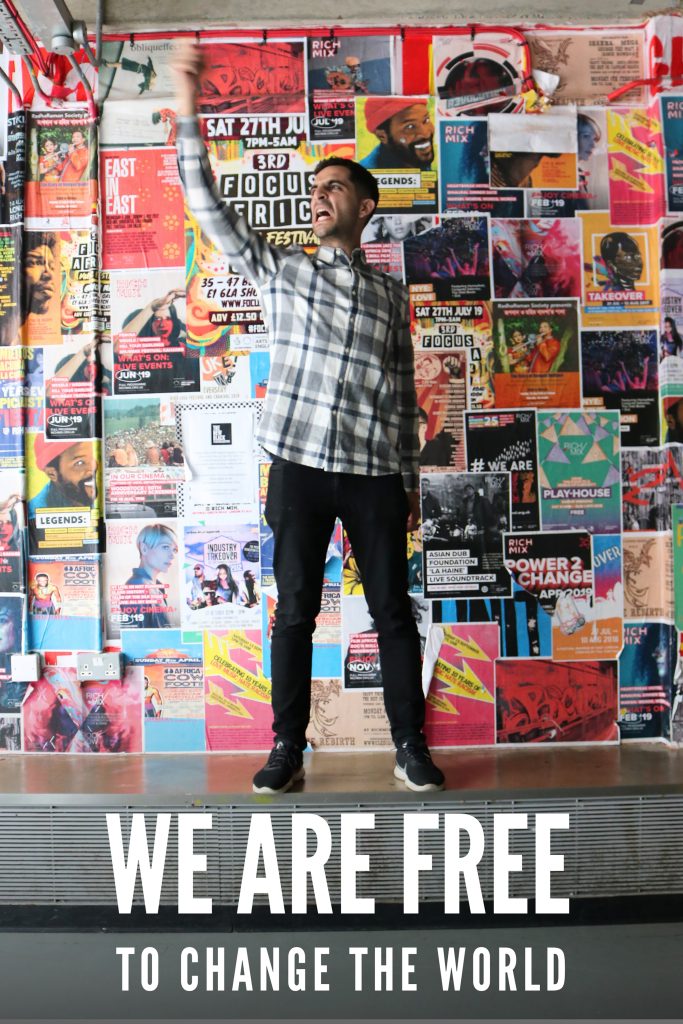
Image credit: Poster for We Are Free To Change The World
