

Becca Voelcker: Rewilding the Lens

Image: Garden Pieces (1998) Dir Margaret Tait, Courtesy of Margaret Tait and LUX, London. See film on Wed 5 Nov 2025, 19:00. barbican.org.uk
As the world prepares for COP30 in Belém, Brazil, we turn to Dr Becca Voelcker – BBC New Generation Thinker 2024, writer, curator, and Lecturer in Art at Goldsmiths – whose work explores the urgent relationships between land, cinema and extraction. Her Land Cinema series at the Barbican (5–26 November 2025) arrives as a timely act of cultural reflection, foregrounding visionary filmmakers from Japan to Brazil who reimagine how we see and live with the earth. Voelcker’s forthcoming book, Land Cinema in an Age of Extraction (University of California Press), expands this conversation, tracing fifty years of creative resistance to environmental and colonial exploitation. Off-duty, she can be found forest-bathing among the oaks of Hampstead Heath or savouring London’s more unapologetically niche cultural havens – from Raven Row to Bard Books – reminding us that curiosity, like the planet, thrives when tended with care.
Your research often maps how land, cinema and extractive culture interconnect across continents – from Japan to Mali to Wales. From that wide-angle view, how do you see artists and filmmakers today reshaping global conversations about land, ecology and justice? Are you feeling hopeful?
I’m encouraged that many artists and filmmakers today are reshaping global conversations about land, ecology and justice – not least, the Brazilian filmmaker Ana Vaz, whose films will close out the month-long season of Land Cinema at the Barbican Centre on November 26th. Vaz’s films explore land as a site of encounter between different species, peoples, and ways of seeing. They transport us between wild grasslands, modernist highways, and even a zoo, mapping how colonial and extractive ways of thinking have sought to master people, land, animals and plants. Vaz has a unique, very poetic language as a filmmaker, and with this, she recasts the camera from a historical role in objectifying colonised people and places, to becoming a tool for telling powerful stories of struggle and resistance.
This is also what the Chinese filmmaker Zhang Mengqi does, making films with her neighbours in the Hubei village that she now calls home. Relocating from Beijing to her grandparents’ village, Zhang marks an important shift in priorities towards rural and ageing communities that China’s rapid economic and urban development overlooks.
Likewise for the Filipinx and Taiwanese American artists Enzo Camacho and Ami Lien, who make film, art and ecology projects with farmers on a sugarcane plantation island in the Philippines, focusing on a long-exploited ecology and community is a vital act of climate justice.
Learning about such projects – and then sharing them through my writing, broadcasting, and film curating – brings me hope and reminds me that brave, creative people are everywhere, working towards change.

Image: Red Persimmons (2001) Dir Ogawa Productions and Peng Xiaolian. See film on Wed 12 Nov 2025, 18:45. barbican.org.uk
You’ve spoken about growing up in rural North Wales, surrounded by quarries and open landscape. How did that early relationship with land and place shape the way you see the world – and how you read images on screen?
I was born and raised in a very remote part of Eryri, so I benefitted from great freedom to run around outdoors. This undoubtedly gave me a fierce love of nature.
Eryri is beautiful: it’s a National Park with deep valleys and craggy peaks. But the land is also wounded, baring the scars of English colonialism and extractive industries—visible in the abandoned slate quarries, for example. Growing up there gave me a sense of nature’s power and its vulnerability.
Eryri is a Welsh-speaking area, and I was raised bilingually, feeling how language can shape someone’s sense of place and identity. In my research on land cinema, when I watched films that combine Navajo and American English, for example, or Colombian Spanish and Guambiano, I recognised some of the complexity of land- and language-based identity from my own background.
My early relationship with rural land also influenced my fascination with cities, partly motivating my move to Tokyo, as well as stints in New York and London. Observing how people build, occupy and share space differently in urban and rural settings fascinates me.
Rural and bilingual Wales gave me a richer sense of perspective. Much of my research in film and art centres on asking questions of images: whose perspective is this? whose perspective is missing? why?
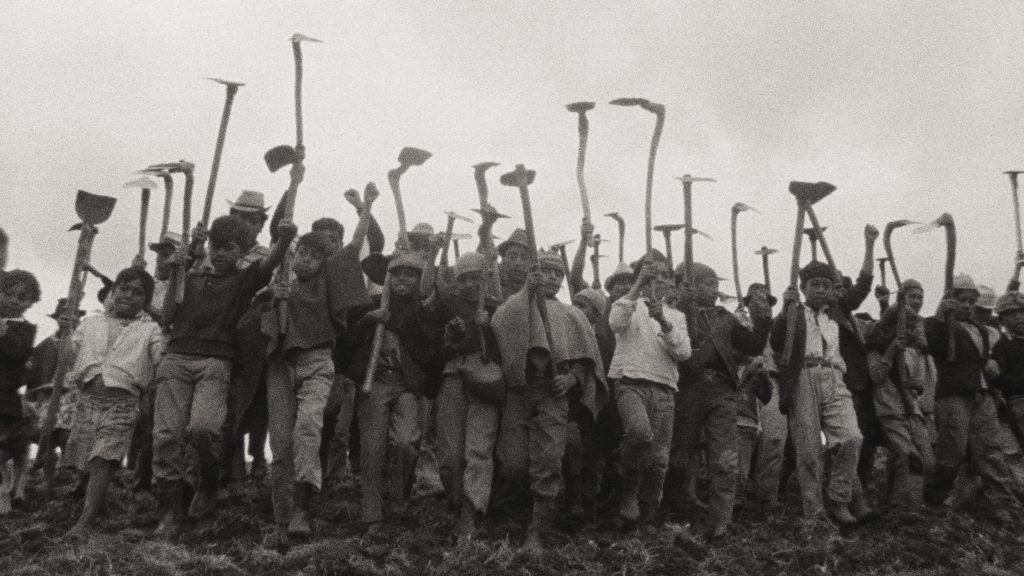
Image: Our Voice of Earth, Memory and Future (1981) Dir Marta Rodríguez and Jorge Silva. See film on Wed 19 Nov 2025, 18:30. barbican.org.uk
Your Barbican series Land Cinema draws together films that treat land not as scenery but as an active, political subject. What inspired you to bring this series to a public audience now, and what conversations do you hope it sparks in the current cultural moment?
As I was writing the book, people often asked me where they could watch land cinema films. My answer was frustrating, as many land cinema filmmakers eschewed mainstream channels of funding and distribution, favouring grassroots networks and community screenings. Fifty years on, as the importance of their films is increasingly understood, copies circulate film festivals and arts centres. But still, many films are hard to find. I knew that launching the book had to coincide with launching a film series, to bring some of the films to wider audiences. I’ve long admired the Barbican Centre’s film programme, and so it seemed like a natural home for land cinema’s premiere as a series.
Another motivation for bringing the series to a public audience is to inspire a younger generation with some of the courageous and creative work for climate justice that has occurred over the past half-century. I find the idea that ‘it’s easier to imagine the end of the world than the end of capitalism’ very unhelpful. Land cinema shows that alternatives can exist and have existed. The evidence is there, in the footage of a former plantation in Mali that is now an organic farming cooperative, or in shots of rejuvenated land that focus on the growth of ecosystems rather than GDP.
Trailer for Land Cinema series, 5-26 November, barbican.org.uk
If you could pick two films from the Land Cinema season that best capture its spirit – maybe for audiences new to this way of seeing – which would they be, and why?
Our Voice of Earth, Memory and Future (showing on November 19th), is a poetic experimental documentary made by the Colombian filmmakers Marta Rodríguez and Jorge Silva in collaboration with Indigenous advisers from the Cauca region. Made over five years, the film merges documentary and dream-like fiction as it incorporates Indigenous modes of storytelling to dramatise a history of imperial land grabbing and grassroots opposition. I find that film captures land cinema’s spirit in the way it combines critical and creative ways of seeing, and was made in such a collaborative process.
Similarly critical and creative is Ana Vaz’s It Is Night In America (showing on November 26th). This film offers a haunting depiction of the wondrous wild creatures who inhabit Brasília as fugitives in the modern, concrete city.
Your upcoming book Land Cinema in an Age of Extraction traces how filmmakers around the world have grappled with resource economies and environmental crisis since the 1970s. What drew you to this period, and how do you see those historical works speaking to today’s ecological urgencies?
I’m interested in the 1970s because that decade saw a dramatic growth both in extractive industries and emissions, and in new forms of environmentalism developing in tandem with feminist and anti colonial justice movements. Both the extractivism and activism of that era shape our present day.
I belong to a generation that faces an uncertain ecological and political future. Wondering what happened in the decades immediately preceding my birth to cause our present predicament, I began researching extractivism and its damages. During this research, I also found myself wondering who resisted this. Land cinema unearths remarkable stories of resistance. Today, while images of climate crisis often lack critical context regarding causality, present misery as if there was no alternative, and leave us in paralysed alarm, land cinema offers inspiring images and grounded evidence as possible blueprints for the future. I find history most exciting when it lets us hold up a lens to see our present more clearly. Learning about the 1970s also taught me about today, how we got here, and where we might go next.
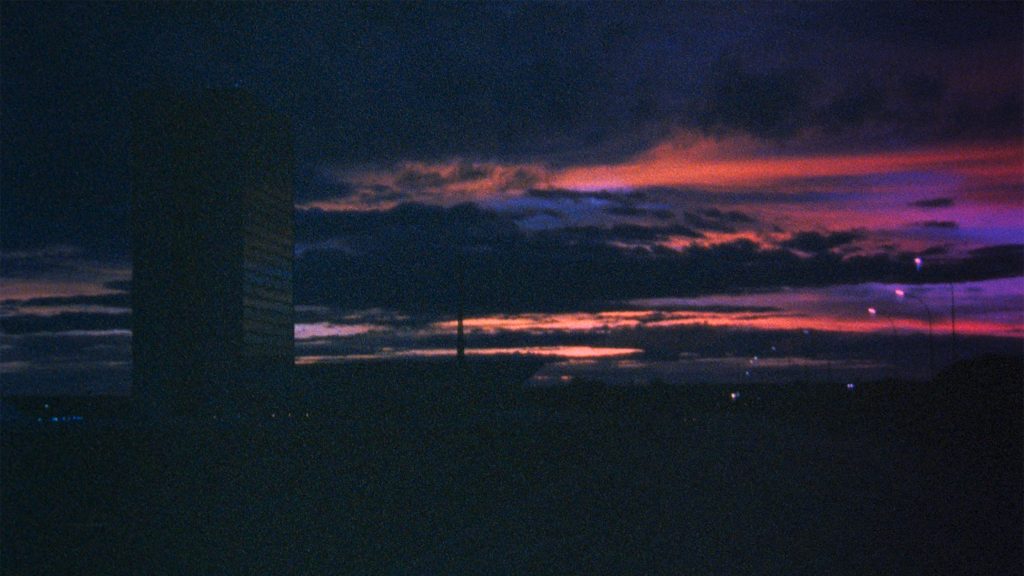
Image: It Is Night in America (2021) Dir Ana Vaz, Courtesy of the artist and Fondazione in Between Art and Film. See film on Wed 26 Nov 2025, 18:30. barbican.org.uk
You describe Land Cinema as a way of “thinking with land” rather than simply filming it. What does that mean in practice for the filmmakers you study – and perhaps for us, as viewers?
All images of land require political and ecological decoding. Land cinema filmmakers emphasised their own perspectives and material ways of working to invite audiences to look carefully and ask questions: How has land come to look this way? Whose land is it? Whose perspective are we seeing?
Sometimes, land cinema filmmakers including Anne Charlotte Robertson and Margaret Tait (whose garden films launch the Barbican’s Land Cinema season on November 5th) choose close-up and low angles as they film, approximating the perspective of a cat, a bird, or a flower. In so doing, they shift us from a wholly human-centred position to consider the points of view of other inhabitants of the land. Filmmakers including Rodríguez and Silva, meanwhile, use reenactment to explore the layers of memory and buried history that reside within the land. Their films encourage audiences to think about land in a longer timeframe, both as a place of ancestral significance and a source of life for generations to come. Extractive practices such as mining, logging, or landfill make little sense when you learn to see land as a home that sustains multiple generations of human and other-than-human beings.
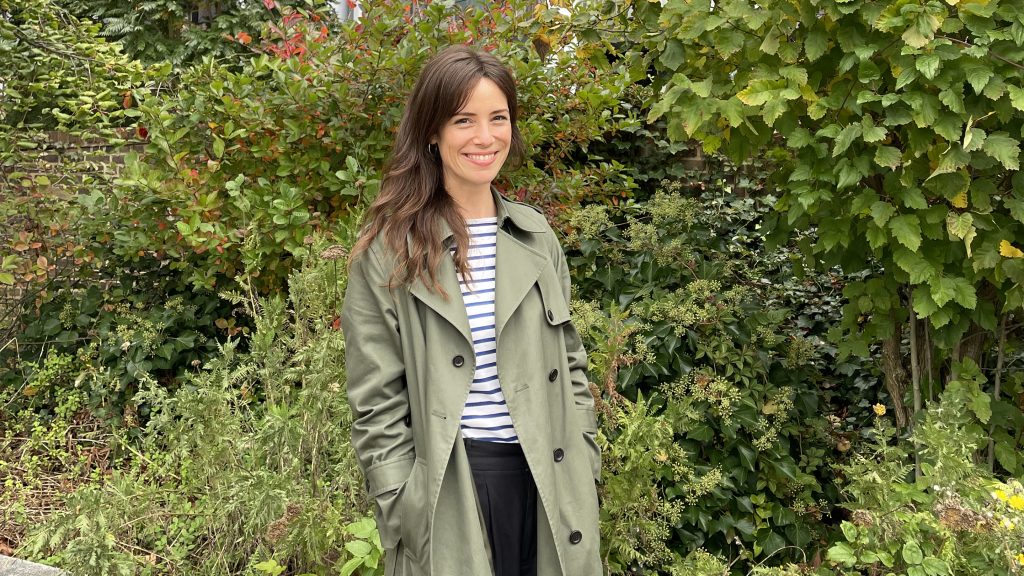
Image: Photo of Becca Voelcker
If we were to follow you on a day of “London land cinema,” where might you take us? Could you share three of your favourite London places – landscapes, cultural spaces, or corners of the city – that feed your curiosity or ground your thinking?
I ground myself by walking amongst the very old oak trees in Hampstead Heath and smelling the leaves and soil (in Japan this is called shinrin-yoku, or forest bathing). Nearby, Kenwood House and its rolling lawns and artificial bridge offer an interesting reminder of how picturesque British landscapes and cultivated gardens often hide tales of extraction. Much of London is like this, including the City near Bank whose architecture and street names carry clues for its embroilment in empire. Six in the City’s walking tour exploring London’s connections to slavery was an eye opener on this, and I’ve never looked at the City in the same way again.
Remembering that land cinema isn’t all landscaped gardens and greenery, any London itinerary would also have to visit some of the most unaffordable and inhospitable land in the city today. Empty mansions whose owners live abroad, benches designed so that no one can rest on them, spiked windowsills to repel birds, astroturf lawns, traffic…
But in the spirit of land cinema’s creative energy, we’d then spot some hopeful alternatives amidst all the grey. Dalston Curve Garden, and the Story Garden at King’s Cross, are examples of thriving community-led green spaces. Or a recent favourite: Culpeper Community Garden in Angel. This is a tranquil haven of flowers and trees, tended by volunteers and available to vulnerable people seeking solace in nature. I find this sanctuary, which is evidently so loved and looked after, very reassuring.
And finally, staying close to the ground – what’s exciting you right now in London’s cultural grassroots? Could you name three projects, collectives or happenings that you think our readers should have on their radar?
I always keep an eye on Raven Row, as its exhibitions are unapologetically niche, sincere, in-depth, and politically awake. And it’s free.
I recently participated in an event at Bard Books on Roman Road, which was a new venue for me – a bookshop with excellent coffee and wine and a regular programme of evening events – what a nice combination!
I’m a loyal supporter of LUX, which grew from London Filmmakers Co-op, and is currently based in the tranquil surrounds of Waterlow Park. I admire LUX’s consistent, quiet championing of artist filmmakers from around the world, through screenings, talks and a public archive.
Find Becca at beccavoelcker.com
Land Cinema
A season of rare films that sowed the seeds for climate justice today. From Japan to Brazil, Boston to Orkney, these films reveal how land shapes all of our lives.
Wed 5 – Wed 26 November
barbican.org.uk
Land Cinema in an Age of Extraction
By Becca Voelcker
Published by University of California Press, 16 December 2025
Available for pre-order now
ucpress.edu