

Grace Nicol: I’ve always been a person of action
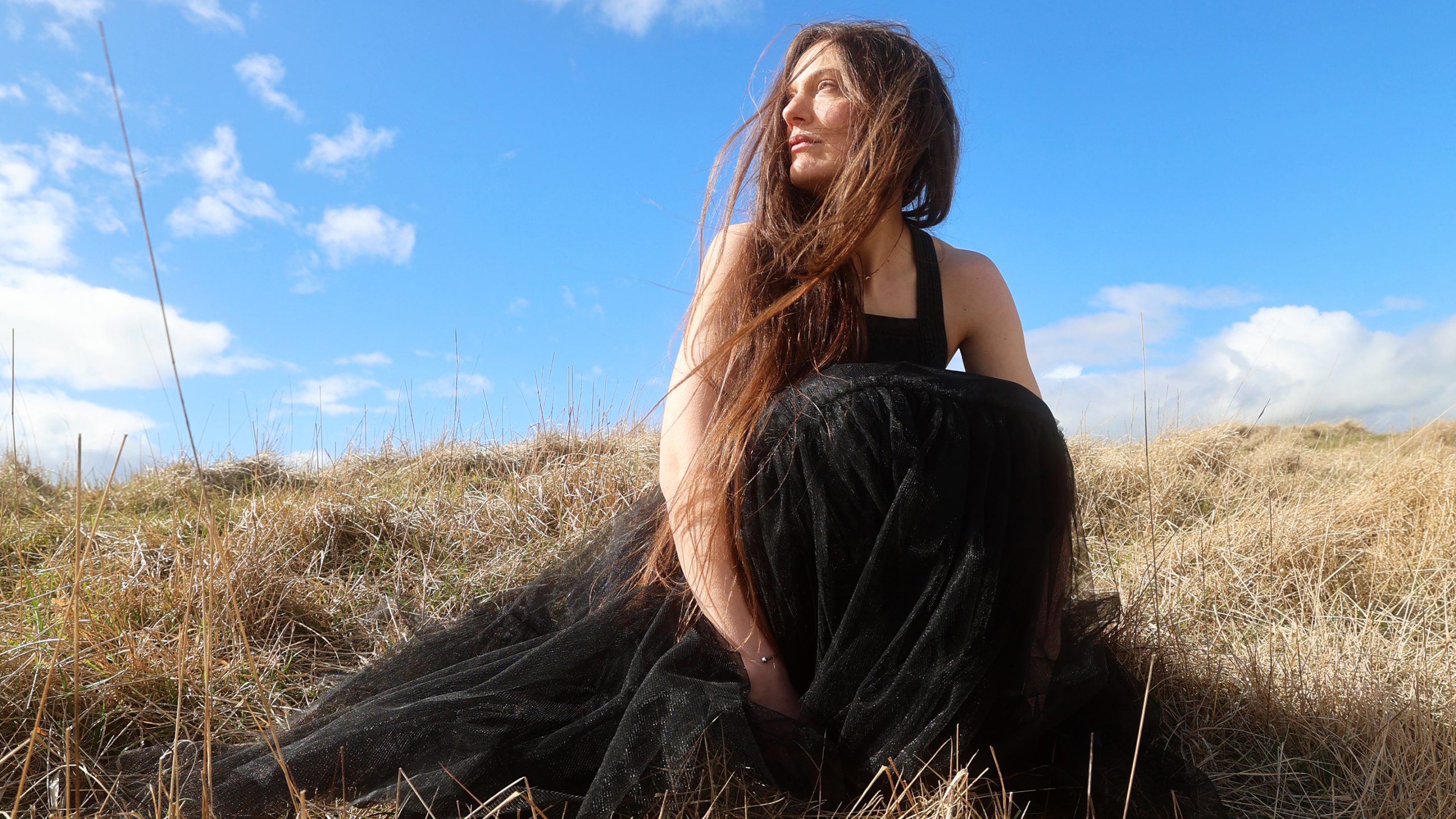
Image Credit: Grace Nicol, photographed by Sarika Thakorlal
Grace Nicol has long been one of London’s most radical forces – a choreographer, movement director, educator and care-driven agitator whose work moves fluidly between galleries, runways, film sets and communal dancefloors.
This season she reunites with long-time collaborator Sinéad O’Dwyer for a new durational performance at the Barbican’s Dirty Weekend, their first true co-authored piece since 2018, and continues her evolving partnership with Jeremy Deller, where humour, politics and public space collide. As Site-Specific Module Leader at London Contemporary Dance School (LCDS), Grace has teamed up with the National Gallery, where her students will perform for December’s Friday Lates – expanding what dance can mean inside institutional walls. Alongside this, she co-founded the Pastoral Care Offer, reflecting her unwavering commitment to community, transparency and artist wellbeing.
Grace’s journey is one of action, integrity and possibility – a model for independent practice on one’s own terms.
You’ve been working with Sinéad O’Dwyer for years, weaving movement into her fashion worlds and vice versa. For the Dirty Weekend at the Barbican, you’re co-creating a piece together again. What’s it like returning to that creative friendship – what’s changed, and what’s deliciously the same?
This collaboration feels very different to the roles I’ve previously held in Sinéad’s practice and the roles she’s had supporting mine. The last time we truly co-authored a work was in 2018, when we first met, and quickly realised how closely our artistic languages aligned.
Sinéad’s work centres embodied experience, sensation and materiality, all of which resonate deeply with my own approach to choreography. We both care about how bodies actually feel and navigate space, and we both work from a place of care and lived experience.
What has changed is the shared shorthand and trust we’ve built over the years, which allows us to take creative risks together. What remains the same is the curiosity, playfulness and depth we bring to each other’s practices.
For Dirty Weekend, we’re staging a durational performance that explores character, sensuality and the agency of objects. It convenes a constellation of archetypes from the brand’s world, constantly shifting through their interaction with clothing and space. The work creates intimate and heightened moments as performers navigate the edges of sensation and the relationships between body, material and gaze.
In the summer of 2025 you worked with Jeremy Deller – and have an ongoing collaboration with him. What draws you to artists like Jeremy, who bend history, politics, humour and community into art? Where do your practices meet?
I feel like Jeremy’s work is profoundly aligned with who he is as a person. He holds space for people in a genuinely generous way, and he cares deeply for the communities he works with. That sincerity is rare, and it’s essential to me.
There is currently (and has been for a while) huge pressure on artists to demonstrate ‘impact’. For us to show ourselves to be socially engaged, pedagogical, reparative often in ways that replace what should be state responsibility. At times, this can distort artistic intention. With Jeremy, that burden doesn’t flatten the work. He makes art that is aesthetically ambitious and socially resonant because that’s embedded in his ethics, not retrofitted afterwards. Humour is also a shared point. Humour creates permeability and invites connection and recognition.
Another point of overlap is a question I’m continually asking: what theatrical contract are we entering? Most of my work takes place outside of traditional theatres, precisely because I feel removing those conventions can open new relationships with audiences. In theatres, audiences sit silently, in the dark, follow an expected etiquette, and pay increasingly prohibitive ticket prices. This shapes who can enter, how they behave, and who feels welcome.
Working with Jeremy is exciting because his work is intentionally for everyone. And yet the artistic integrity remains uncompromised.
My own roots come from folk dance. My parents play in a ceilidh band, so I grew up being put to sleep in guitar cases or being strapped to my mum as she played the drums. That sense of collective embodiment of stories, folk and community, is something I think we both hold dearly.
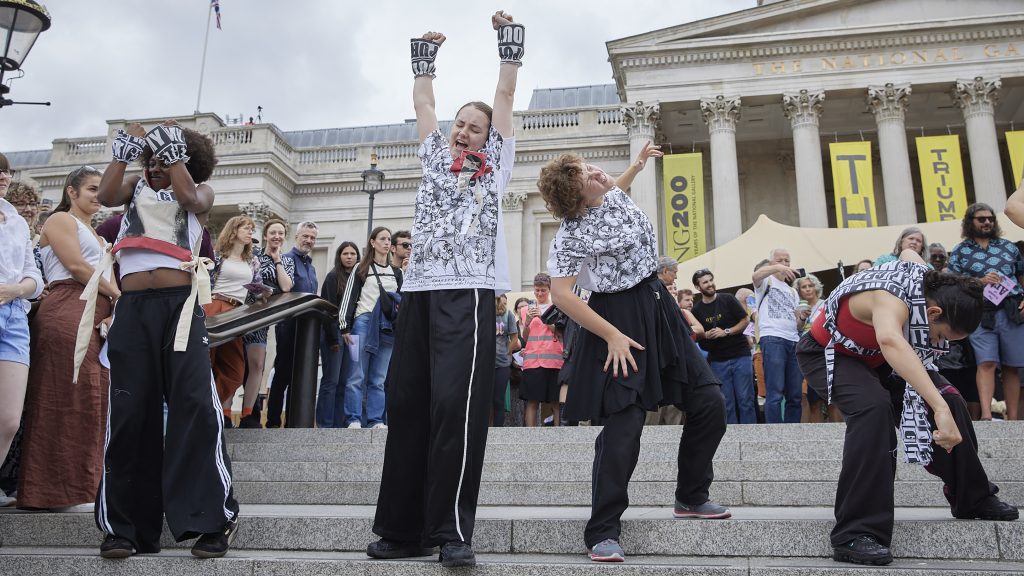
Image Credit: ‘Hogarthian Rave’ by Jeremy Deller and Grace Nicol. Performed by LCDS. Photo by National Gallery.
You’re currently the Site-Specific Module Leader at LCDS (London Contemporary Dance School), and have brokered a partnership with the National Gallery – your students perform at Friday Lates in December. What excites you about teaching site-specific work right now? And what’s it like watching a new generation negotiate art institutions in their own way?
I think that students are incredibly attuned to institutional context, power structures and histories. This makes teaching inside complex spaces (like museums and galleries) rich and challenging. The LCDS students are critical thinkers. They are articulate, curious, politically aware, and embrace rigorous embodied enquiry.
Within the module, I introduce them to bodies, space and objects through a new-materialist lens but looking at the agency of matter, without erasing individual context. We work with clay, keepsakes, and objects of use. We spend time with curators to understand the layered histories embedded in collections. We look at the idea that a moving, breathing body in a gallery is still seen as something disruptive that needs to be managed and that in some galleries there is a particular canon and set of expectations attached to them, which could cause unease or distress from people encountering something (like dance) that they don’t expect to see there. At the same time, we explore the potential of dance to open up different ways of understanding a space or an artwork.
It means a lot to me that the National Gallery has welcomed the students and is giving them a platform during the Lates. It is a vital opportunity for them to share their work publicly and expand what performance can mean in that environment.
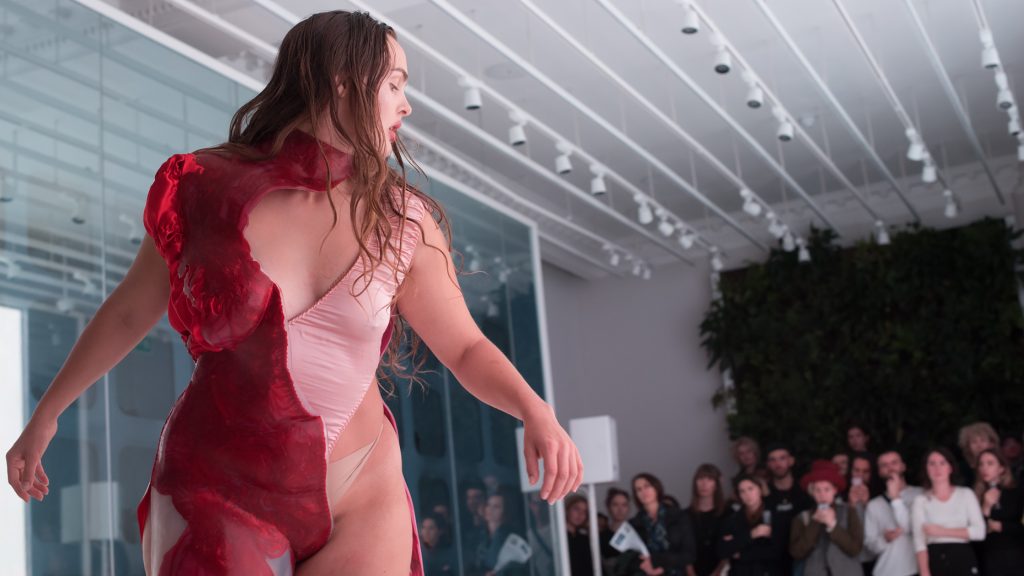
Image Credit: ‘Slip Mould Slippery’ by Grace Nicol and Sinead O’Dwyer. Performed by Becky Namgauds. Photograph by Mario Bertieri.
Your choreographic work and your commercial/fashion/film work operate in parallel – different languages, different economies, yet recognisably “Grace”. How do you navigate those shifts? And what does each world give you that the other can’t?
I see choreography and movement direction as distinct practices, though they inform each other constantly.
Movement direction is fundamentally about facilitating another person’s artistic vision. It requires deep listening and sensitivity to what directors and performers need, helping to bridge communication and offer subtle shifts that can clarify intention.
My own practice absolutely shapes the way I work commercially. I feel like I bring a choreographic understanding of how we can create and be together in a space. This is something that isn’t always foregrounded in commercial contexts and often generates trust from performers and models, partly because of my approach and, potentially, partly because I’m not entrenched in commercial hierarchies!
Commercial work has taught me to really trust my skill set, and to rely on the abilities of others. You have to respond quickly, with limited time and resources, which has sharpened my ability to stay creative in the moment. When I started, I was scared I’d get into the room and draw a blank because I would have to ‘be creative’ on the spot but luckily that has never happened! And there is usually a wealth of expertise in the room to draw from.
By contrast, making my own work offers space to follow the ideas I want to explore, but often with fewer resources and people involved. In dance you frequently end up holding multiple roles out of necessity. Working commercially has reminded me that this doesn’t have to be the case. For example, when working on the Hogarthian Rave with Jeremy, I worked with Theo Clinkard as dramaturg, and this was invaluable. He has a way of reframing everything in such a beautiful way with a single sentence.
Both worlds feed each other, but in different registers.
Looking back – can you pinpoint an early moment, memory or object that sparked your fascination with bodies, objects and the politics of space?
I don’t think there is a single origin point, but my earliest experiences of dance were communal (ceilidhs, family gatherings, my mum picking us up and dancing around the kitchen with us). Dance was woven into daily life rather than set apart. That sense of collective movement has stayed with me.
Over time, this developed into an interest in how dance exists outside theatres: in public, in galleries, in spaces where we can reconnect with movement as something innate and shared.
Encountering artists like Kira O’Reilly or Raimund Hoghe furthered my interest in objects and space to how objects can hold and transform a choreographic encounter. My own experiences showing work in galleries, including moments of censorship, sharpened my awareness of how bodies challenge institutional space.
Those accumulations formed the trajectory I’m on now.
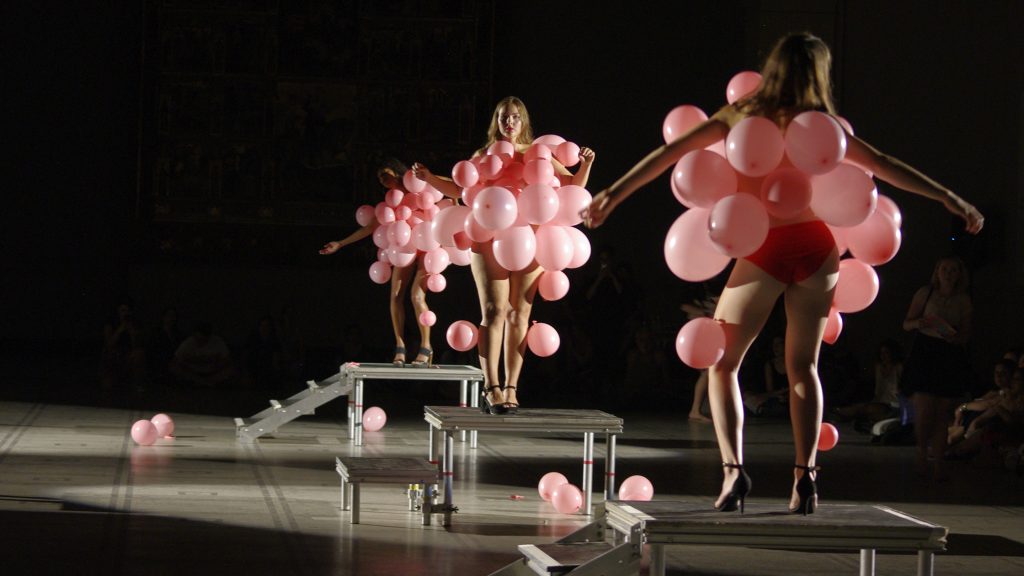
Image Credit: ‘Balloons’ by Grace Nicol. Photograph by Nina Robinson.
You’ve spent more than a decade carving out an independent practice on your own terms. What values have kept you anchored? And what have you learned about sustaining yourself in an industry that often asks too much for too little?
I’ve always worked multiple jobs alongside my artistic practice (some of them feed it and others are just money jobs). For a long time, I felt almost ashamed of that, as if it indicated failure. But it’s the reality for many artists who aren’t financially supported and don’t have family wealth. I think we need to be more honest about that (for ourselves as well as the people coming into the sector now).
Large institutions and companies have the resources, space and time; most freelancers do not. That doesn’t mean the work is any less valuable, but it does mean we must build our practices pragmatically, creatively, and collectively. I would, of course, like this to shift but I think it’s better to be realistic about where we are at.
I’ve consciously resisted scarcity thinking. If you internalise scarcity, you start seeing peers as competition instead of collaborators. I’ve always been a person of action. We actually have a running joke with my siblings that my sister is the pretty one, my brother is the clever one and I’m the one that does stuff! For me, instead of looking for someone to create an opportunity for me or create space, I’ve just thought how can I carve out a space for my work and for others.
That feels essential, ethically and politically.
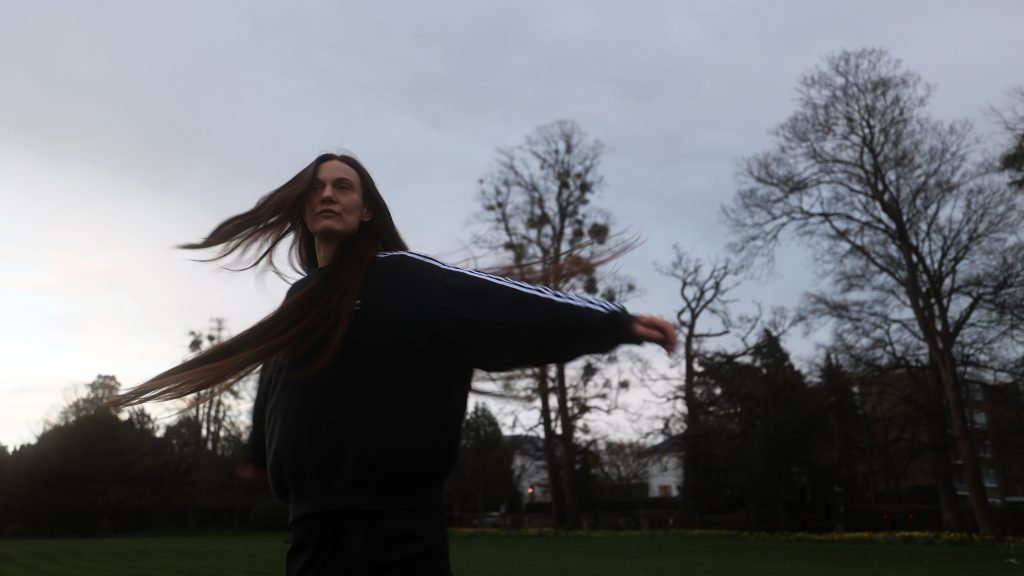
Image Credit: Grace Nicol, photographed by Sarika Thakorla.
You’ve always built and nurtured communities – from the Pastoral Care Offer, to your teaching, collaborations and writing for Run Riot. What does community mean to you today? And how do you protect that sense of care within your own working life?
We are all, fundamentally, searching for community.
The Pastoral Care Offer, which I co-founded with Temitope Ajose in 2020, grew from a desire to rebuild the sector with sustainable practices after the pandemic. We wanted to support the individual inside artistic processes and address the feeling among freelancers of being dropped into isolated, disconnected projects with little structural care.
Community, for me, is built through sustained relationships, accountability, and shared nourishment, not just shared labour.
Finally, where in London do you currently feel most alive? Which three cultural spaces, scenes or communities are giving you that spark of possibility?
House of Momo, Dalston: It holds a very personal significance for me. Many important friendships have been fed and formed there including my relationship with my partner. Even our cat is named after it.
Epping Forest: It offers the possibility of nature without leaving the city. It has marked significant moments for me, including multiple lockdown birthdays.
Walthamstow Trades Hall: The karaoke nights are iconic, the atmosphere is joyous, and it feels like a space where community is genuinely alive (and where drinks won’t bankrupt you).
Find Grace at grace-nicol.com and on Instagram @gracebnicol
Dirty Weekend Live:
Di Petsa / Sinéad O’Dwyer (18+)
With Choreography by Grace Nicol
29 Nov 2025, 17.00
barbican.org.uk
Friday Lates student takeover
London Contemporary Dance School
With Choreography by Grace Nicol
Friday, 12 Dec, 18:30-20:00
nationalgallery.org.uk